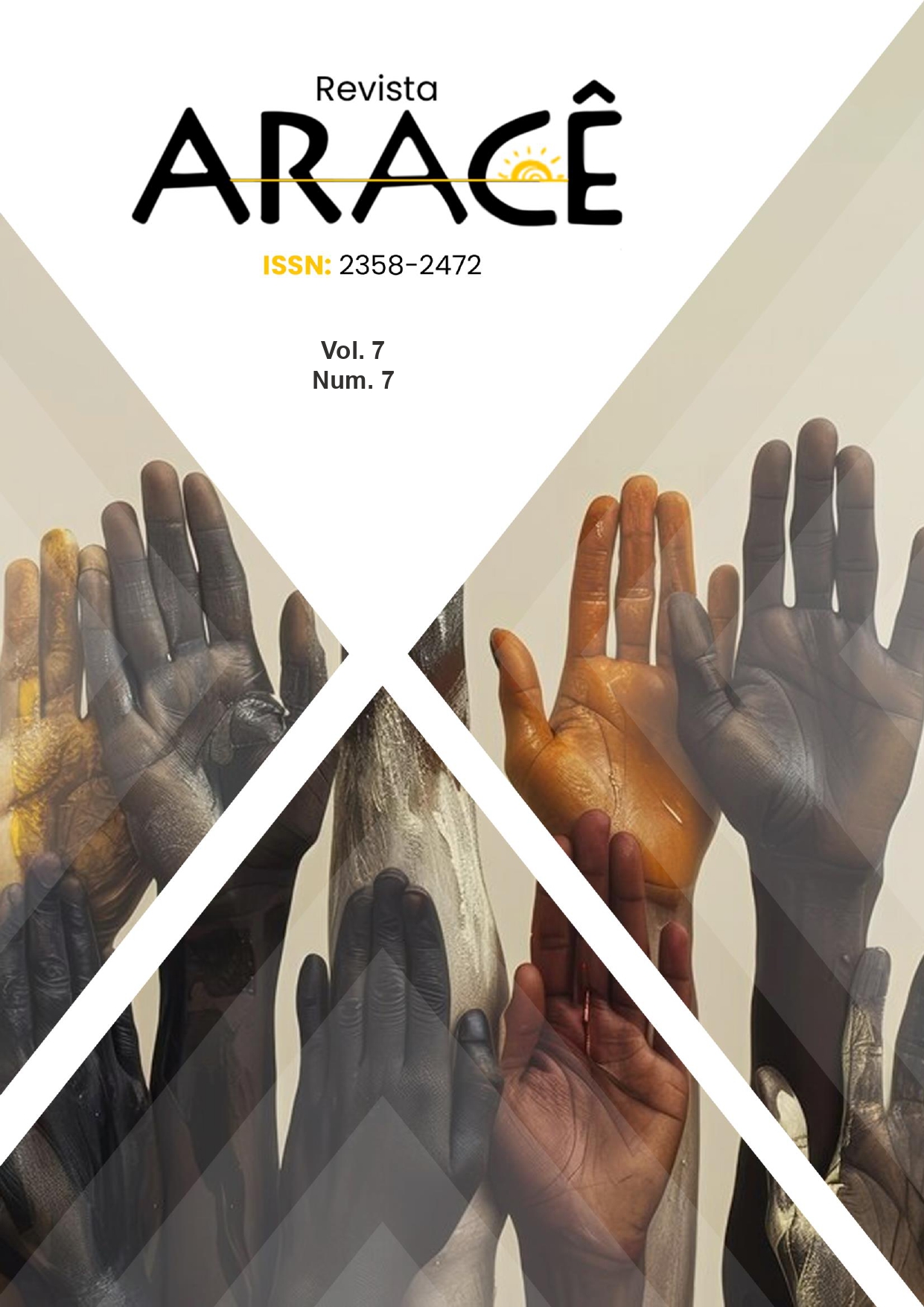
BLACK TEACHING METHODOLOGIES – TERREIRO, CROSSROADS, AND BLACKENING PEDAGOGIES ACCORDING TO NILMA LINO GOMES, LÉLIA GONZALEZ, AND BELL HOOKS
DOI:
https://doi.org/10.56238/arev7n7-101Keywords:
Black Methodologies, Decolonial Pedagogy, Antiracist Education, Blackened CurriculumAbstract
ABSTRACT
In an educational scenario marked by deep racial, epistemological, and affective inequalities, Black teaching methodologies emerge as powerful possibilities for disrupting and reinventing traditional ways of producing knowledge. Thus, this article aims to explore the foundations and practices of terreiro pedagogies, crossroads pedagogies, and pedagogies of Blackening, understanding them not merely as didactic-pedagogical alternatives, but as manifestations of resistance, ancestry, and identity affirmation. Moreover, it is worth noting that these pedagogies are rooted in symbolic and cultural territories historically marginalized by the coloniality of knowledge, finding in authors such as bell hooks, Lélia Gonzalez, and Nilma Lino Gomes relevant ethical-political and theoretical references. Therefore, the object of this study is the critical and interpretive analysis of the contributions of bell hooks, Lélia Gonzalez, and Nilma Lino Gomes to the construction of Black teaching methodologies, with emphasis on the processes of subjectivation, belonging, and social transformation produced by these perspectives in school and community spaces. The general objective, then, is to understand how these authors challenge conventional educational logics and open paths to pedagogical practices committed to curriculum Blackening, the valorization of diasporic knowledge, and the construction of antiracist affective bonds. The guiding question of this investigation is: in what ways can terreiro pedagogies, crossroads, and Blackening, according to bell hooks, Lélia Gonzalez, and Nilma Lino Gomes, transform educational spaces into territories of emancipation, belonging, and dignity for Black students? The theoretical framework centers on the works of hooks (2009; 2013; 2015; 2018; 2019), Gonzalez (1988; 2014; 2021), and Gomes (2007; 2011; 2012; 2017), and draws on orbital references such as Anzaldúa (2012; 2015; 2022), Moraga (2002; 2022), Fanon (2008; 2022), Collins (1999; 2004; 2006; 2012; 2016; 2019), Munanga (2015), Lobato (2021), Ratts (2014), Moraga and Anzaldúa (2002), Anzaldúa and Keating (2015), Moraga, Anzaldúa and Bambara (2002). The research is qualitative in nature (Minayo, 2007), bibliographic and descriptive (Gil, 2008), based on a comprehensive analytical approach (Weber, 1949). The findings reveal that Black teaching methodologies break with Eurocentric pedagogy by valuing affection, ancestry, and belonging as formative principles. Such practices make it possible to reconfigure the school into a territory of dignity and resistance for Black students, challenging epistemicide and fostering collective and politicized learning bonds. Furthermore, these pedagogies expand educational potential by integrating memory, spirituality, and the body as foundations of a situated, insurgent, and emancipatory knowledge.
Downloads