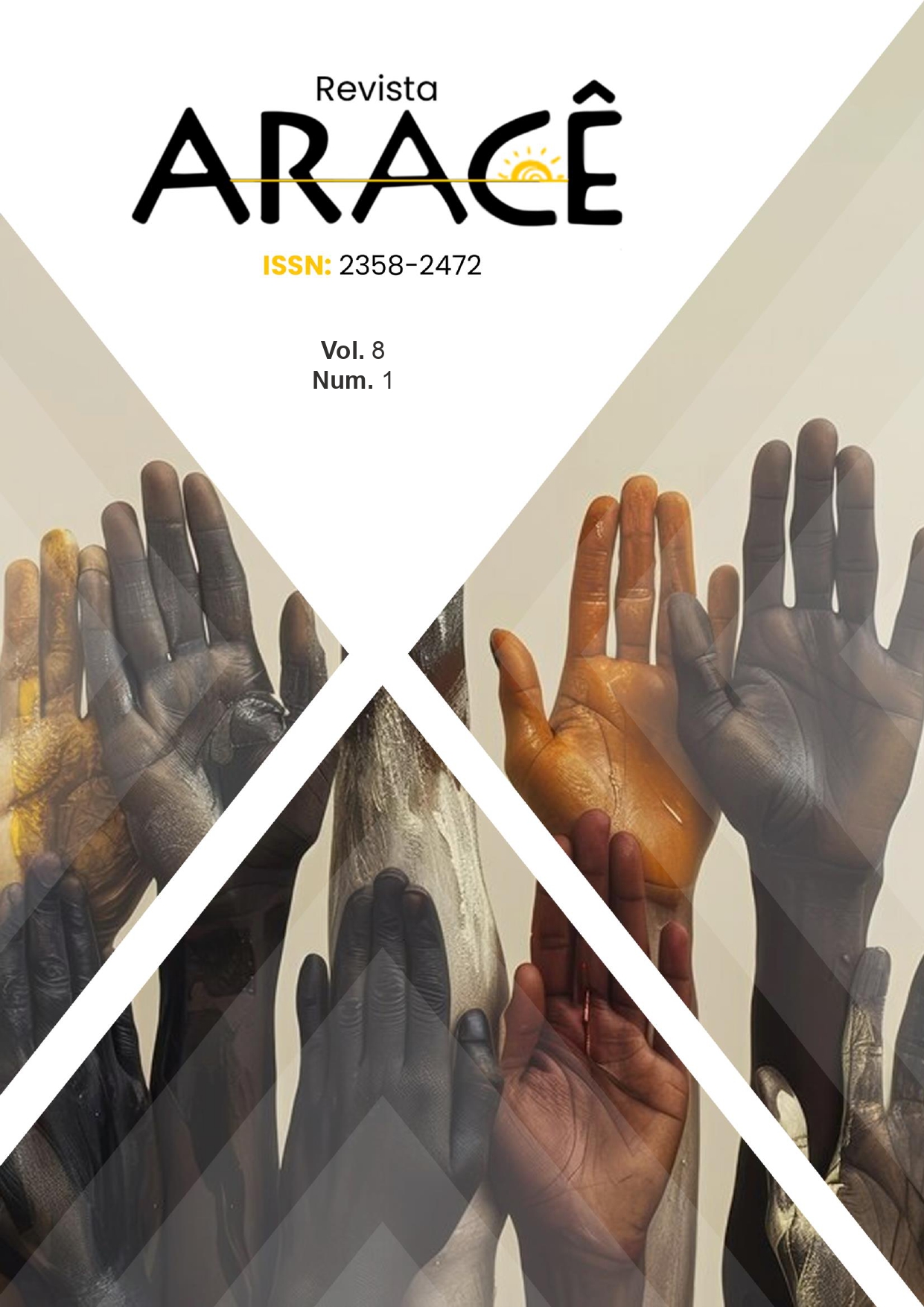
YOUTH AND ADULT EDUCATION: PERSPECTIVES OF RESIDENTS OF SLUMS AND URBAN PERIPHERIES
DOI:
https://doi.org/10.56238/arev8n1-135Keywords:
Youth and Adult Education, Socio-Educational Inequalities, Territory, Popular Education, EquityAbstract
Considering the profound social, territorial, and educational inequalities that have historically shaped Youth and Adult Education (Educação de Jovens e Adultos – EJA) in Brazil, especially in the contexts of urban slums and peripheral areas, this article problematizes this educational modality as a public and subjective right whose implementation remains constrained by structural processes of exclusion. The study aims to critically analyze EJA based on the experiences and living conditions of individuals residing in these territories, discussing the meanings attributed to this modality within Brazilian educational policies. To this end, the article adopts a qualitative theoretical essay approach, grounded in a critical analysis of the academic literature on EJA, popular education, and structural inequalities, in dialogue with authors such as Freire (2004), Arroyo (2017), Paiva, and Julião (2019). The analysis reveals that educational policies aimed at EJA have historically been marked by a compensatory and utilitarian character, often subordinated to labor market demands and correction-of-flow logics, which limits access, permanence, and educational success for students in this modality. It is concluded that strengthening EJA requires its affirmation as a space for human, political, and emancipatory education, guided by the principle of equity and the recognition of differences, overcoming reductionist practices and reaffirming education as an instrument of social justice.
Downloads
References
ARROYO, Miguel G. Passageiros da noite: do trabalho para a EJA Itinerários pelo direito a uma vida justa. Petrópolis, RJ: Vozes, 2017.
BRASIL. Conselho Nacional de Educação. Parecer CNE/CEB nº 11/2000, de 10 de maio de 2000. Institui as Diretrizes Curriculares Nacionais para a Educação de Jovens e Adultos. Brasília, CNE, 2000a. Disponível em: http://portal.mec.gov.br/secad/arquivos/pdf/eja/legislacao/parecer_11_2000.pdf. Acesso em 22 jan. 2019.
BRASIL. Conselho Nacional de Educação. Resolução CNE/CEB nº 1/2000, de 5 de julho de 2000. Estabelece as Diretrizes Curriculares Nacionais para a Educação de Jovens e Adultos. Brasília, DF, 2000b. Disponível em: http://portal.mec.gov.br/cne/arquivos/pdf/CEB012000.pdf. Acesso em: 22 out. 2018.
CARRILLO. Affonso Torres. A educação popular como prática política e pedagógica emancipadora. Educação popular: lugar de construção social coletiva. Danilo R. Streck, Maria Teresa Esteban (Orgs).Petrópolis, RJ. Vozes, 2013.
FREIRE, Paulo. Pedagogia da autonomia. São Paulo : Editora Paz e Terra, 2004.
. Pedagogia da indignação: cartas pedagógicas e outros escritos. São Paulo : Editora Unesp, 1997.
. Pedagogia do Oprimido. Rio de Janeiro : Editora Paz e Terra, 1981.
. Pedagogia do Oprimido (2ª ed.). Porto: Afrontamento, 1975.
MORAES, Bianca Mota; GONÇALVES Clisânger Ferreira; VICENTE, Débora da Silva & JULIÃO, Elionaldo Fernandes. Políticas Públicas de Educação. Ministério Público do Rio de Janeiro/Universidade Federal Fluminense, 2019.
PAIVA, Jane. Contradições na formulação das políticas de educação: inclusão/exclusão, autonomia, cidadania, qualidade como consequência dos fatores legais e de financiamento. Ministério Público do Rio de Janeiro/Universidade Federal Fluminense, 2019.
PATROCÍNIO , Paulo Roberto Tonani. Favela, Periferia e Subúrbio, territórios da diferença. Disponível em: 2017_1522191585.pdf (abralic.org.br)Acesso em 20 de julho de 2023.
UNICEF, Fundo das Nações Unidas para a Infância. Panorama da distorção idade-série no Brasil, 2017. Disponível em: Panorama_da_distorcao_idade-serie_no_Brasil.pdf (unicef.org). acesso em 28 de julho de 2023.