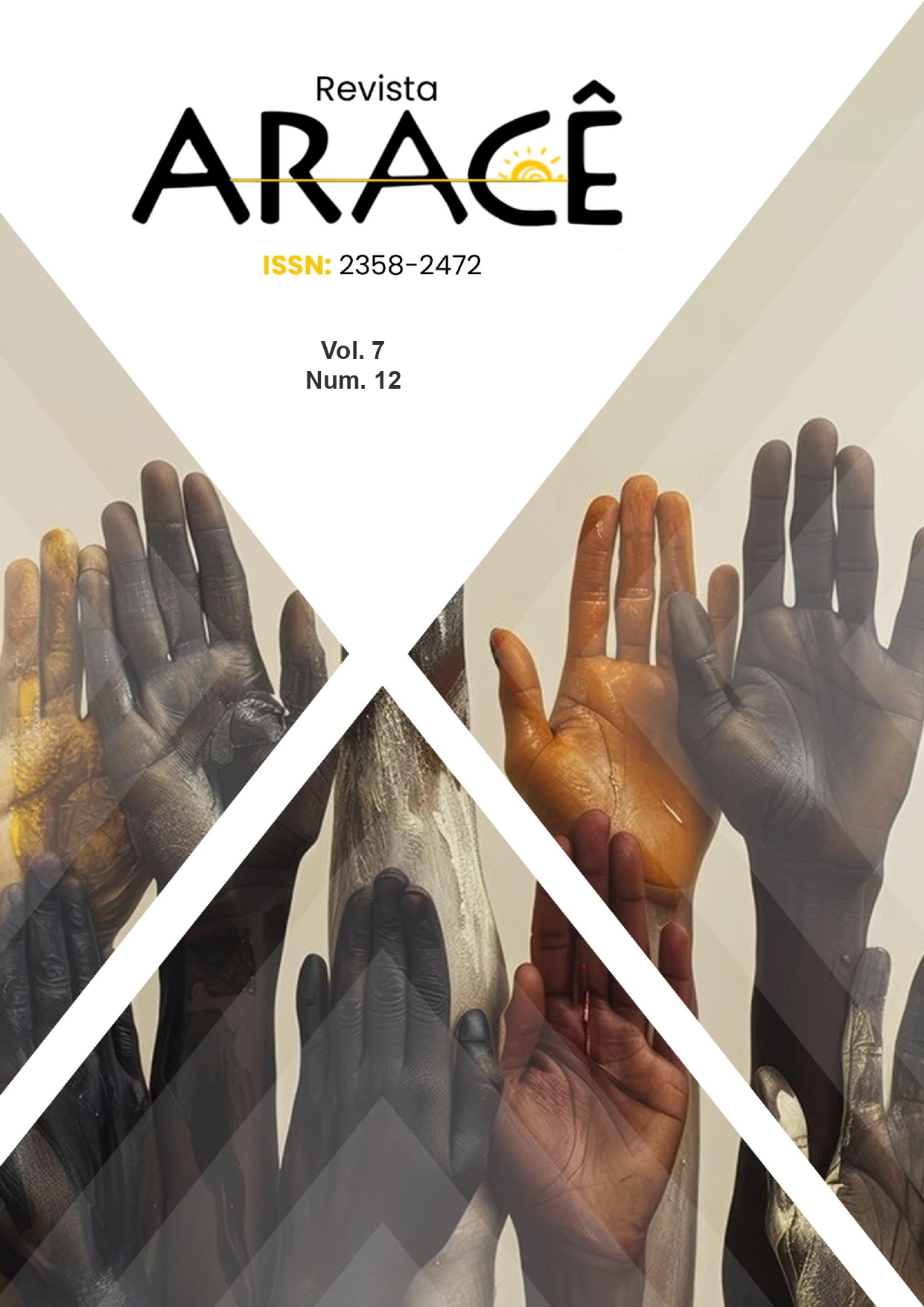
RACIALIZACIÓN, SESGO ALGORÍTMICO Y PODER EN LA ERA DE LA INTELIGENCIA ARTIFICIAL: UN ANÁLISIS CRÍTICO DE LAS NUEVAS ARQUITECTURAS TECNOLÓGICAS
DOI:
https://doi.org/10.56238/arev7n12-342Palabras clave:
Inteligencia Artificial (IA), Algoritmos, Sesgo Algorítmico, Racismo AlgorítmicoResumen
Este artículo analiza la relación entre la tecnología, la inteligencia artificial y las cuestiones raciales, destacando cómo los sistemas automatizados reflejan valores y sesgos que pueden exacerbar la discriminación y las disparidades sociales. Se discuten los conceptos de racismo algorítmico y racismo estructural presentes en la creación, implementación y uso de tecnologías como el reconocimiento facial, los sistemas de selección automatizados y las plataformas en línea. Desde una perspectiva foucaultiana del biopoder, se enfatiza la importancia de cuestionar la supuesta neutralidad tecnológica, mostrando cómo las decisiones automatizadas pueden intensificar la opresión racial mediante prácticas de segregación digital, reforzando estereotipos. También se examinan aspectos históricos y teóricos relacionados con el progreso tecnológico y sus implicaciones sociopolíticas, especialmente en el contexto actual de poder y control social. Finalmente, este estudio busca contribuir a la reflexión sobre la justicia y la equidad en el uso de la inteligencia artificial.
Descargas
Referencias
ALAGIĆ, A. et al. Application of artificial intelligence in the analysis of the facial skin health condition. IFAC-PapersOnLine, 2022. v.55, n.4, p.31-37. Disponível em: <https://doi.org/10.1016/j.ifacol.2022.06.005>.
ARROYO, C. L. Constitución, Derechos Fundamentales, Inteligencia Artificial Y Algoritmos. Revista do Direito, 2022, n.66, p.139-158.
BENJAMIN, Ruha. Race After Technology: Abolitionist Tools for the New Jim Code. Oxford: Oxford University Press, 2019.
BHBOSALE, S.; PUJARI, V.; MULTANI, Z. Advantages and disadvantages of artificial intelligence. Aayushi International Interdisciplinary Research Journal, 2020, v.77, n.October, p.227–230. Disponível em: <https://towardsdatascience.com/advantages-and-disadvantages-of-artificial-intelligence-182a5ef6588c>.
BOONIPAT, T. et al. Using artificial intelligence to analyze emotion and facial action units following facial rejuvenation surgery. Journal of Plastic, Reconstructive and Aesthetic Surgery, 2022, n.XXV, p.8-10.
BUOLAMWINI, Joy Adowaa. Gender Shades: Intersectional Phenotypic and Demographic Evaluation of Face Datasets and Gender Classifiers. B.S. in Computer Science, Georgia Institute of Technology, 2017. Massachusetts Institute of Technology.
BUOLAMWINI, Joy & GEBRU, Timnit. Gender shades: Intersectional accuracy disparities in commercial gender classifcation. In Conference on fairness, accountability and transparency. Proceedings of Machine Learning Research, v.81, pp.1-15, 2018. In: http://proceedings.mlr. press/v81/buolamwini18a/buolamwini18a.pdf. Acessado em 20 jun.
CARPENTER, K. A.; HUANG, X. Machine learning-based virtual screening and its applications to Alzheimer’s drug discovery: a review. Current pharmaceutical design, 2018, v.24, n.28, pp.3347-3358.
CORMEN, Thomas H. et al. Algoritmos: Teoria e Prática. 3.ed. Rio de Janeiro: Elsevier, 2012.
ELIAS, P. S. Algoritmos, Inteligência Artificial e o Direito. ConJur, 2017. Disponível em: <https://www.conjur.com.br/dl/algoritmos-inteligencia-artificial.pdf>. Acesso em: 3 out. 2022.
FOUCAULT, Michel. História da sexualidade I. Trad. Maria Thereza da Costa Albuquerque e J. A. Guilhon Albuquerque. Rio de Janeiro: Edições Graal, 1998.
FOUCAULT, Michel. Vigiar e Punir: Nascimento da Prisão. 42.ed. Petrópolis: Vozes, 2020.
HAN, Byung-Chul. Sociedade do cansaço. Trad. Enio Paulo Giachini. Petrópolis: Vozes, 2025.
HAYKIN, S. Neural Networks and Learning Machines. New Jersey: Prentice Hall, 2008.
HELMOND, ANNE. A plataformização da web. In: OMENA, J. J. Métodos Digitais: Teoria-Prática-Crítica. Lisboa: ICNOVA, 2019. pp.49-72.
HIMANSHU; KHANNA, R.; KUMAR, A. Artificial intelligence applications for target node positions in wireless sensor networks using single mobile anchor node. Computers and Industrial Engineering, 2022. v.167, n. February.
MASTRODICASA, D. et al. Artificial Intelligence Applications in Aortic Dissection Imaging. Seminars in Roentgenology, 2022.
MIRA, J. M. Symbols versus connections: 50 years of artificial intelligence. Neurocomputing, 2008. v.71, n.4-6, p.671-680.
MOACIR, R. F. de M. & PONTI, M. A. Machine learning A Practical Approach on the Statistical Learning Theory. [S.l.]: [s.n.], 2017. v.45.
NAKAMURA, L. & CHOW-WHITE, P. Introduction - Race and Digital Technology: Code, the Color Line and Information Society. In: NAKAMURA, L. CHOW-WHITE, P. (Orgs.). Race after the internet. New York: Routledge, 2012, pp.1-18.
NOBLE, Safiya Umoja. Algoritmos da opressão: como o Google fomenta e lucra com o racismo. Santo André, SP: Rua do Sabão, 2021.
O’NEIL, Cathy. Algoritmos de destruição em massa: como o Big Data aumenta a desigualdade e ameaça à democracia. Trad. Rafael Abraham. Santo André, SP: Rua do Sabão, 2020.
PEIXOTO, F. H. Direito E Inteligência Artificial Na (Não) Redução De Desigualdades Globais: Decisões Automatizadas Na Imigração E Sistemas De Refugiados. Revista Direitos Culturais, 2020, v.15, n.37, p.305-320.
SHAPIRO, S. C. Encyclopedia of artificial intelligence second edition. New Jersey: A Wiley Interscience Publication, 1992. p.1-9.
SILVA, T. Colonialidade difusa no aprendizado de máquina: camadas de opacidade algorítmica na internet. In: SILVEIRA, S. A. da; SOUZA, J. & CASSINO, J. F. (Orgs.). Colonialismo de Dados. São Paulo: Autonomia Literária, 2021. pp.87-108.
SILVA, T. Racismo Algorítmico em Plataformas Digitais: microagressões e discriminação em código. VI Simpósio Internacional LAVITS – Assimetrias e (In)Visibilidades: vigilância, Gênero e Raça, 2019b. pp.1-17.
SOUSA, Vinicius Dino de. O problema do algorithmic bias (viés algorítmico) no auxílio aos juízes de Direito pela inteligência artificial: Uma investigação sobre a imparcialidade e injustiça da inteligência artificial. 2020, https://www.jusbrasil.com.br/artigos/o-problema-do-algorithmic-bias-vies-algoritmico-no-auxilio-aos-juizes-de-direito-pela-inteligencia-artificial/825348884. Acessado em 15/08/2024.
SWEENEY, Latanya. Discrimination in Online Ad Delivery (28 de janeiro de 2013). Disponível em SSRN: https://ssrn.com/abstract=2208240 ou http://dx.doi.org/10.2139/ssrn.2208240.
TRIVEDI, R. & KHADEM, S. Implementation of artificial intelligence techniques in microgrid control environment: Current progress and future scopes. Energy and AI, 2022, v.8, n. March, p.1-19.
TSIKTSIRIS, D. et al. A Novel Image and Audio-based Artificial Intelligence Service for Security Applications in Autonomous Vehicles. Transportation Research Procedia, 2022. v.62, n. Ewgt 2021, pp.294-301.
TUFEKCI, Z. Algorithmic Harms beyond Facebook and Google: Emergent Challenges of Computational Agency. Colorado Technology Law Journal, 13, pp.203-218, 2015.
ZHOU, J. et al. Application of artificial intelligence in the diagnosis and prognostic prediction of ovarian cancer. Computers in Biology and Medicine, 2022, v.146, n. February, p.105608. Disponível em: <https://doi.org/10.1016/j.compbiomed.2022.105608>.
ZHU, L. et al. Can artificial intelligence enable the government to respond more effectively to major public health emergencies? Taking the prevention and control of Covid-19 in China as an example. Socio-Economic Planning Sciences, 2022, v.80, n. December 2020, pp.1-9.
ZUBOFF, S. A era do capitalismo de vigilância. Rio de Janeiro: Intrínseca, 2021.